
GATTACA: Separating the Science from Science Fiction
By Bella Hardee
All images in this article are taken from the 1997 movie GATTACA, directed by Andrew Niccol and produced by Columbia Pictures.
Additional Note: This article is not related to nor about the preimplantation genetic testing company named Gattaca Genomics, founded in 2022.
If you haven’t seen this 1997 classic film, GATTACA stars Ethan Hawke, Uma Thurman, and Jude Law. It is about a futuristic society in which most children have their genes chosen for them, and their genetics determine their social status. Though genetic discrimination against individuals is illegal, it’s rampant. Employers exploit loopholes, and the justice system blatantly ignores discriminatory practices due to bribes and other unnamed forms of corruption.
Ethan Hawke plays Vincent Freeman, an “In-Valid” whose parents conceived him naturally. He has a heart condition that’s never stated or explained, just vaguely alluded to. All Vincent wants is to be an astronaut, but he is doomed to a life as a janitor due to his “condition.” The movie focuses on Vincent becoming a “stolen ladder,” someone who steals another person’s identity, including their genetic identity. Vincent meets Jerome Eugene Morrow (Jude Law), an ex-Olympic swimmer forced into retirement due to an accident that left him paralyzed from the waist down. Jerome can’t swim or work because of his disability, and he sells his genetics to Vincent. This allows Vincent to become an astronaut while also paying for Jerome to maintain the high-dollar lifestyle he lived before the accident. Uma Thurman plays Vincent’s love interest, Irene. She starts to suspect “Jerome” is lying about who he is and investigates him when a murder takes place at their office.
GATTACA was released in 1997 as a science fiction film, but I wanted to dig into what from the movie is fiction, fact, or horribly wrong to begin with (some spoilers ahead).
Movie: When Vincent is born, they take a blood sample to test his entire genome and receive the results back in minutes.
Real Life: When the movie came out, the test would’ve been inspired by newborn blood spot tests. The newborn blood spot test usually takes weeks to return, and it only tests for common conditions that might drastically impact quality of life at a young age. (Newborn Screening, 2024) Since the onset of NGS technologies, hospitals now have rapid WGS tests similar to the movie, but even these take at least a week to have results
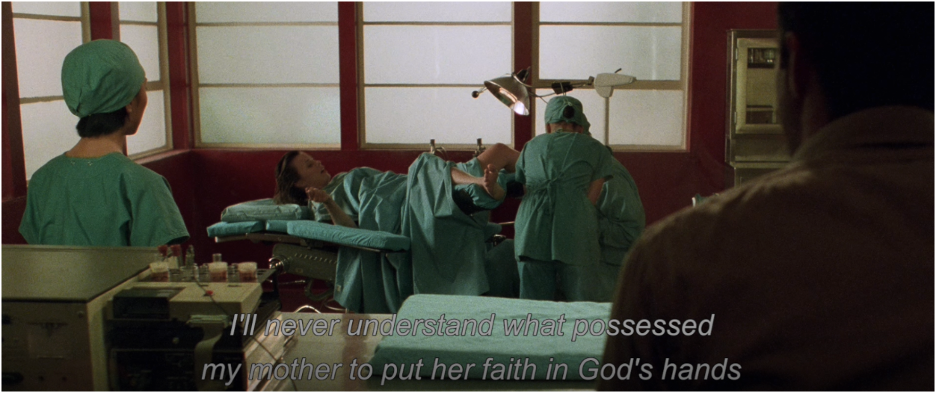
A screenshot from 9:32 into Gattaca. A woman wearing teal scrubs gives birth in a red room. The closed captioning from Vincent Freeman says, “I’ll never understand what possessed my mother to put her faith in God’s hands.”
Movie: All embryos undergo Whole Genome Sequencing so parents can pick and choose their child's traits.
Real Life: Preimplantation genetic testing can help prevent genetic diseases and determine a child's sex. You cannot choose whether your child will be left-handed or right-handed or have blue eyes (Preimplantation, 2026).
Movie: All employees use a finger prick to verify their identity and get into work.
Real Life: Biometric security measures have come a long way since 1997. While they still feel fictional at times, most phones now have facial ID or fingerprint technology (DHS, 2025). As of now, there is no biometric system that collects a blood sample. Currently, companies have developed a biometric scanner that can identify the vascular map in a hand or finger for identification, but it is not in widespread use (Rony Chowdhury, 2025).
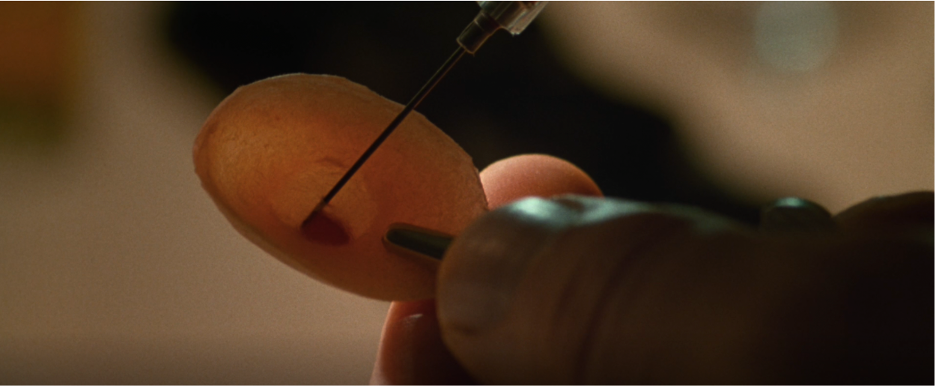
A screenshot from 3:27 into Gattaca. Vincent Freeman injects blood into a prosthetic thumb cover.
Movie: Irene suspects “Jerome” (Vincent) is lying about his identity. She takes his hair to a government office for testing. The woman next to her has her lips swabbed to get the DNA of the man she kissed recently. Irene receives the entire sequence back in moments, the results rolled into a tube. The laboratory tech even mentions a rating of 9.3 and says, “What a catch.”
Real Life: GATTACA’s world has thrown out the idea of medical privacy. While the movie has a love story woven into it, it barely touches on the problems that arise when anyone can have another person’s DNA sequenced at any time, especially in the dating world. The tech, which cites a rating of 9.3, strongly implies that everyone is rated from 1 to 10, further objectifying individuals in this world. Also, test results for every possible genetic condition would likely not fit in a 9-inch tube.
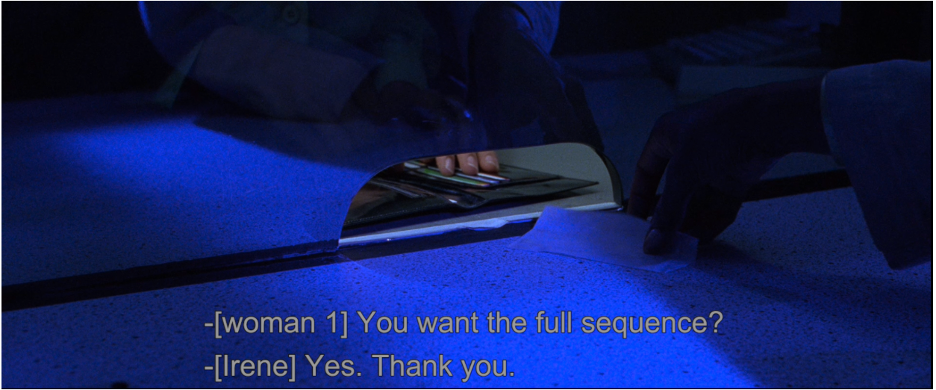
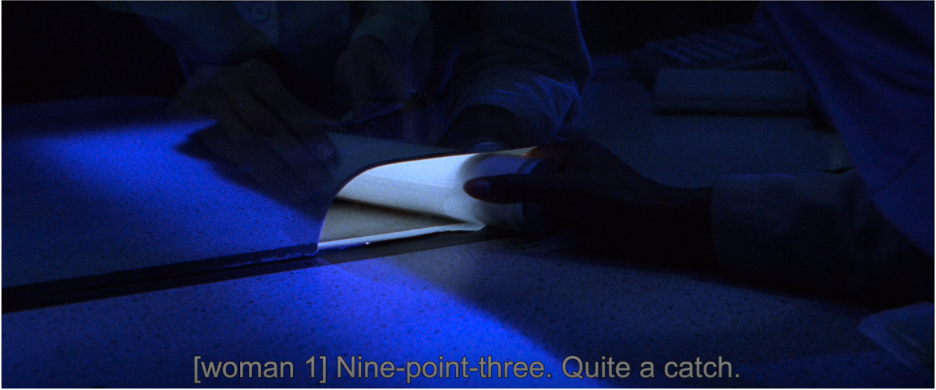
The image from 37:58 in Gattaca shows Irene handing a small bag from her wallet to a lab tech. The closed captioning says [woman 1] You want the full sequence? [Irene] Yes. Thank you. The lower image, from 38:21 in Gattaca, shows woman 1 handing back a 9-inch tube to Irene and saying, "[woman 1] Nine-point-three." Quite a catch.
Movie: We see a brief glimpse of “Jerome’s” DNA after Irene has his hair sequenced. The listed conditions are: “AAT deficiency, abnormal aortic anurism, acanthamoeba keratitus, and accelerated hypertension.” The listed conditions are alphabetical diseases, not the character’s own diagnoses.
Real Life: AAT Deficiency is most likely Alpha-1 Antitrypsin Deficiency, which is real (Alpha-1 antitrypsin, 2022). Abnormal aortic anurism could be familial thoracic aortic aneurysm and aortic dissection (Familial thoracic, 2026), but it hurts that they spelled aneurysm wrong. Acanthamoeba keratitis is a parasitic infection from an amoeba (Acanthamoeba, 2025). Accelerated hypertension is an acute, life-threatening emergency that would be diagnosed in the moment, not over a period of time (Vaziri, 1984). Of the 4 conditions shown on a “full genome sequence,” only two are genetic.

The image at 38:42 in GATTACA shows Irene holding a paper with “Jerome Morrow's” genome sequencing results.
Final Thoughts
I enjoyed GATTACA in high school and on rewatch. I think it is an important science fiction film that prompts people to consider whether we will view genetics as predestination, as the Puritans viewed their own lives, or whether we will believe in ourselves and overcome science. While genetic counselors understand that a positive test is multifaceted, many people still assume it is the definitive answer. GATTACA is an early representative of the genetics-themed science fiction that addresses questions about medical privacy and workplace protections, even with minimal references. The premises in this movie could be explored further, such as how dating changes when anyone can have a stranger's DNA tested, or what corporate exploitation looks like when they have access to a person's most personal information. While I do not recommend GATTACA to seasoned sci-fi fans, I believe it is a great piece of media that can inspire students to conduct further research and explore the ethical issues surrounding medical privacy.
Reference List
Acanthamoeba keratitis: Protect your eyes from these microscopic threats. (2025). Cleveland Clinic.https://my.clevelandclinic.org/health/diseases/21560-acanthamoeba-keratitis
Alpha-1 antitrypsin deficiency: Causes, symptoms & treatment. (2022).Cleveland Clinic. https://my.clevelandclinic.org/health/diseases/21175-alpha-1-antitrypsin-deficiency
Biometrics. (2025). U.S. Department of Homeland Security. https://www.dhs.gov/biometrics
Familial thoracic aortic aneurysm and aortic dissection. (2026). Genetic and Rare Diseases Information Center. https://rarediseases.info.nih.gov/diseases/2249/familial-thoracic-aortic-aneurysm-and-aortic-dissection
Newborn screening results and follow-up. (2024). Health Resources and Services. Administration. Newborn Screening Results and Follow-Up | Newborn Screening. https://newbornscreening.hrsa.gov/newborn-screening-process/newborn-screening-results-and-follow
Preimplantation Genetic Testing (PGT). (2026). Cleveland Clinic https://my.clevelandclinic.org/health/diagnostics/preimplantation-genetic-testing-pgt
Rony Chowdhury, M. A. N., & Ahmed, M. N. (2025). Enhancing Biometric Security Through Blood Circulation-Based Fingerprinting: A Novel Approach. Preprints. https://doi.org/10.20944/preprints202502.1278.v1
Vaziri, N. D. (1984). Malignant or accelerated hypertension. The Western Journal of Medicine, 140(4), 575–582.
Whole genome sequencing of babies. (2018) Nuffield Council on Bioethics. https://www.nuffieldbioethics.org/publication/whole-genome-sequencing-of-babies/